🏋️Training Plan
Body Recomposition & Longevity Plan
This is a plan I have made with adding sources into NotebookLM. I have used sources from Rhonda Patrick, Ph.D. (Dr. RP), Andrew Huberman, Jan Hoff (the 4x4 method), and Tim Ferriss. I have also added my personal information, like the vitamins I take, my training sessions, and what I eat (my weekly recipes). Take that into consideration if you use this as information.
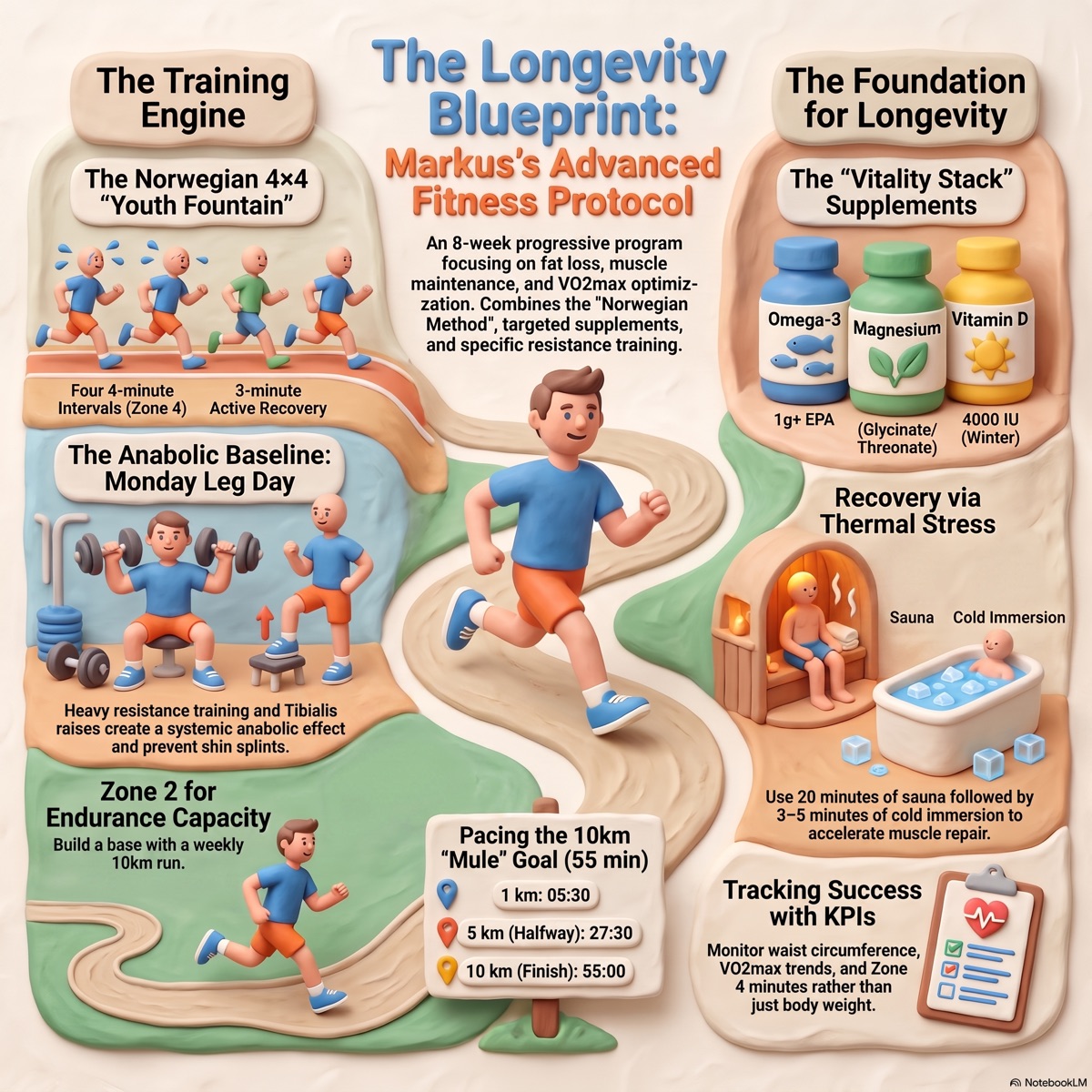
Weekly Plan: Strategic Distribution & Fasting Adaptation
My weekly plan is not something I follow religiously. Because of my work, I need to adapt it to my hours at the café. However, I do try to follow the training order, although I sometimes have to do my strength training at home using only dumbbells.
| Day | Session & focus | Time window / intensity | Scientific purpose & fasting synergy |
|---|---|---|---|
| Monday | Strength: Legs & Core — Heavy machine strength + Tibialis & neck | After 12:30 PM (Fed state) | A heavy leg session triggers a powerful systemic anabolic response. Performed within the eating window for optimal energy availability and muscle building. |
| Tuesday | Running: Norwegian 4×4 — High intensity in Zone 4 (157–169 BPM) | Before 12:30 PM (Fasted state) | Maximal oxygen uptake (VO₂max). Fasted aerobic training significantly increases mitochondrial adaptation and fat oxidation. |
| Wednesday | Running: 5 km jog — Moderate, steady pace in Zone 3 (140–155 BPM) | Before 12:30 PM (Fasted state) | Threshold conditioning. Trains the body to clear lactate efficiently during ongoing fasting (promotes metabolic flexibility). |
| Thursday | Strength: Upper body — Torso + neck isolation (chest/back/shoulders) | After 12:30 PM (Fed state) | Preserve upper-body muscle mass during a calorie deficit. Ensures amino acid availability within the eating window. |
| Friday | Active recovery & Sauna — Sauna (<88 °C) + ice bath & ‘snacks’ | Flexible (all day) | Accelerates recovery and stimulates growth hormone. Short, breathless ‘snacks’ improve glucose regulation and insulin sensitivity. |
| Saturday/Sunday | Running: 10 km ‘Mule Day’ — Long run in Zone 2/3 with weighted vest | Before 12:30 PM (Fasted state) | Builds base capacity, endurance, and mental resilience. 100% nasal breathing keeps intensity in Zone 2 during deep fasting. |
Important note on visceral fat & fasting: Dr. Rhonda Patrick says that strength training alone does not remove the dangerous visceral fat around the organs, which is one of my goals for this plan. Therefore, aerobic conditioning is essential. Dr. RP says that doing aerobic exercise before my first meal increases the burning of visceral fat. One important thing about fasting is eating enough carbs and protein for lunch and dinner.
The Training Sessions in Detail (Monday–Thursday)
Monday: Strength — Legs & Core (approx. 50 min) — Fed state
- Heavy base strength: Squats or hack squats (2–3 heavy sets, 5–8 reps to form failure), hamstring curls, and calf raises.
- Tibialis Raises (Ben Patrick): 3 sets of 25 reps (bodyweight against a wall). Strengthens the front of the shin, counteracts shin splints, and prevents knee pain as your running volume increases to 15+ km per week.
Tuesday: Norwegian 4×4 Intervals (approx. 45 min) — Fasted session
- Execution: 10 min warm-up (gradually up to 130 BPM). 4 bouts of 4 minutes at planned pace (e.g. 14.0–14.2 km/h with 1% incline to challenge the legs without spiking the heart rate). 3 minutes of active, easy recovery between bouts (7–8 km/h jog).
- Zone discipline (Hoff protocol): Aim for 14+ minutes accumulated in Zone 4 (157–169 BPM). Avoid tipping into Zone 5 too early or finishing with a maximal sprint. Too high a heart rate (>170 BPM) prevents the heart from filling maximally with blood between beats, which is the very key to increasing stroke volume and VO₂max.
- Fasted advantage: Performing this session in the morning (before 12:30 PM) while fasted forces the body to use the lactate produced during the bouts as direct fuel.
Wednesday: 5 km jog (approx. 25–30 min) — Fasted session
- Execution: Steady, controlled pace on the treadmill in Zone 3 (approx. 140–155 BPM).
- Objective: This session builds threshold conditioning and trains the body to clear lactate efficiently during ongoing effort.
- Fasted synergy: By jogging fasted in Zone 3, you train the body’s ability to use fat as the primary fuel source at moderate intensity (improved metabolic flexibility). Finish the session with a short, beneficial core circuit.
Thursday: Strength — Upper Body (approx. 45 min) — Fed state
- Maintenance & muscle preservation: Bench press, pull-ups/lat pulldown, dips, and shoulder press. Stay in the 6–10 rep range with 2–3 heavy working sets to controlled failure.
- Fasting adaptation: Since you are in a calorie deficit, this session must be run within your eating window (after 12:30 PM) so that amino acids (proteins) are readily available in the blood to repair and preserve upper-body muscle mass.
Recovery & the Scientific Fasting Regimen
Friday: Active Recovery, Heat/Cold & ‘Exercise Snacks’
- Sauna protocol: 20 minutes in the sauna followed by 3–5 minutes of ice bath or cold shower. Important: Keep the sauna temperature below 88 °C (190 °F). Polish research cited by Dr. Rhonda Patrick shows that the cognitive protection against dementia decreases, and the risk actually increases, if the temperature exceeds 90 °C.
- Exercise Snacks (Rhonda Patrick): Do 3 rounds of 3 minutes of air squats, burpees, or brisk stair climbing spread throughout the day. These short, breathless sessions require minimal time but trigger a dramatic improvement in glucose regulation and insulin sensitivity, regardless of whether you are in the fasting or eating window. It also builds mental toughness.
Saturday/Sunday: 10 km ‘Mule Day’ Endurance Run — Fasted
- Execution: Long run on the treadmill or outdoors at a steady average pace of about 5:30 min/km (approx. 55 minutes total).
- Huberman’s weighted vest hack: Use a thin weighted vest of 8–10 lbs (4–5 kg) during the run to increase the metabolic load and strengthen tendons/bones without placing undue stress on the joints.
Deep Dive: The 19:30–12:30 Fasting Protocol (17:7)
I have always had a low appetite in the mornings, something I think I inherited from my father. I have never really eaten breakfast, so my first meal for most of my life has been around 11:00 to 12:00. That means intermittent fasting is really easy for me. I usually eat dinner between 18:30 and 19:30 and don’t eat my first meal until lunchtime, around 12:30.
- Observing the 3-hour rule: Since you stop eating at 7:30 PM, you ensure that your body has completed most of digestion before bedtime. Digestion activates the sympathetic nervous system (fight-or-flight), which raises the heart rate and hinders deep, cardiovascular recovery during sleep (including glymphatic clearance of the brain). Stopping at 7:30 PM is your most important habit for deep sleep.
- The metabolic switch: After about 12 hours of fasting, the liver’s glycogen stores (the energy tank) are depleted. From 7:30 AM to 12:30 PM, you therefore experience 5 hours of pure fat burning (ketosis). The body produces beta-hydroxybutyrate (BHB), which not only burns visceral fat but also dampens inflammation, reduces anxiety (via increased GABA), and strengthens the brain’s cognitive focus and clarity.
- Fasted training: Your running sessions on Tuesday, Wednesday, and the weekend are performed fasted in the morning. This boosts mitochondrial adaptations (you build more and stronger energy factories in the muscles), makes your cells more insulin-sensitive, and increases growth hormone secretion.
- The diet squeeze (WARNING): Since your eating window is reduced to 7 hours (12:30 PM–7:30 PM), you must be extremely disciplined about getting all your ~2350 kcal and 130g of protein in during this time. If you eat too little, the body will begin to break down muscle mass instead of fat. Plan your two large meals (lunch at 12:30 PM and dinner at 7:00 PM) carefully.
Diet, Macronutrient Distribution & Nutrition
Mediterranean Diet & Macro Targets
The plan is supported by a Mediterranean diet with a daily intake of ~2350 kcal. Your macronutrient distribution is strictly configured to protect muscle mass while achieving maximal fat burning:
- Protein (~130g): Provides the necessary amino acids for muscle recomposition.
- Fat (~80g): Essential for hormone production (testosterone), joint health, and absorption of fat-soluble vitamins.
- Carbohydrates (~260g): Provides energy (glycogen) to perform maximally in the 4×4 intervals and the 10 km long runs.
Your Supplements: Product-Specific Optimization
💊 Supplement Adjustments
- Omega-3: Supports mood and reduces systemic inflammation.
- Magnesium: Essential for vitamin D conversion and good sleep.
- Vitamin D: I take this in the winter.
- Multivitamin: Maybe not needed, but not harmful.
- Vitamin C: To avoid getting sick.